
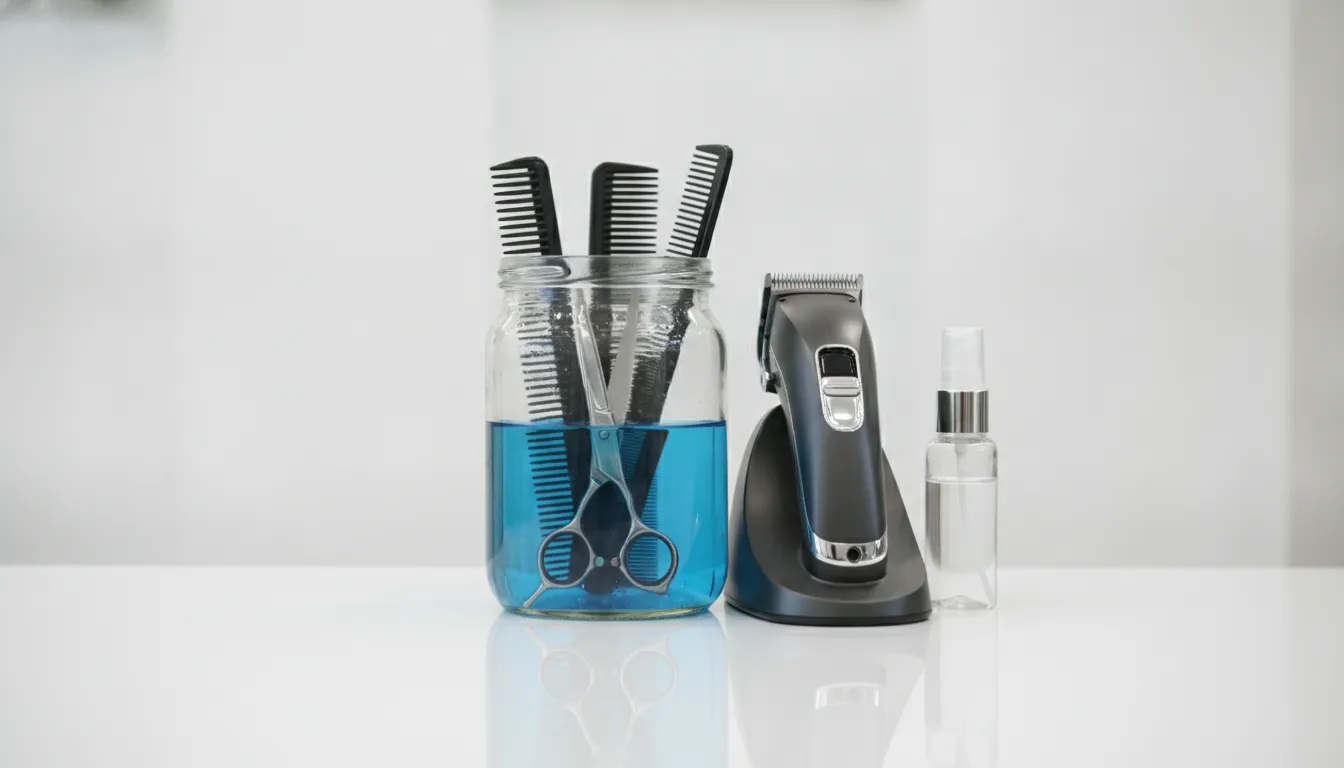
Between clients, the right disinfectant is not simply the strongest-smelling bottle on the shelf. It must be approved for the tool, carry the required label claims, and be used exactly as directed. That distinction matters when a shop moves quickly between clippers, shears, combs, and razors.
Need help choosing a barber tool disinfectant? Call The Barber Company at (702) 900-9972.
A suitable barber tool disinfectant should be EPA registered and labeled for bactericidal, fungicidal, and virucidal activity. Nevada guidance requires barber implements to be disinfected according to the manufacturer’s label, so dilution, application method, wet contact time, rinsing, and drying cannot be guessed or borrowed from another product. Nevada’s barber regulations provide the governing standard.
Start by reading the product label alongside the tool manufacturer’s care instructions. The chemistry and workflow that fit a removable, nonporous blade are not automatically appropriate for an electric clipper or a precision shear. The next step is matching the disinfectant’s approved contents and claims to the tool in front of you.
What Should a Barber Tool Disinfectant Contain?
A suitable barber tool disinfectant is not chosen by color, scent, or a generic brand recommendation. In Nevada, disinfectant used for barber implements must be EPA registered and have bactericidal, virucidal, and fungicidal activity. The product must also be used according to its manufacturer label, which controls the actual procedure.
That standard gives you a practical screening checklist. Look for an EPA registration and label language that identifies bactericidal, virucidal, and fungicidal activity for the type of tool you need to process. Then confirm that the label covers the tool’s material and the intended application method. A product approved for immersion of hard, nonporous implements is not automatically the right choice for an electric clipper or trimmer.
The Nevada barber sanitation requirements make the label part of the operating standard. This matters because two disinfectants can have different use directions. One label may specify a concentrate dilution, while another may be ready to use. Their approved surfaces, required wet contact time, rinsing instructions, and storage directions may also differ.
Why the label matters more than a generic recommendation
Do not copy dilution ratios or contact times from one product onto another. Follow the exact label for the product in your station, including any pre-cleaning requirement. The label should tell you whether the tool is immersed, sprayed, or wiped, how long the surface must remain wet, whether rinsing is required, and how the solution should be stored or replaced.
For example, an EPA label may identify combs, brushes, scissors, clipper blades, razors, and other nonporous instruments for a specific immersion procedure. That example supports only the directions on that label. It does not establish a universal formula or efficacy claim for every barber tool disinfectant. Keep the manufacturer-labeled container available so staff can verify the directions instead of relying on memory.
Match the claim to the tool and workflow
Before purchasing, separate your tools into non-electrical implements and electrical equipment. Shears, combs, and removable blades may have different approved handling from clippers with motors or electrical components. When the label or local requirement is unclear, pause and confirm the approved method with the manufacturer or a knowledgeable supplier. The Barber Company provides professional barber supply guidance for Las Vegas barbers and retail customers, without substituting a store recommendation for the product label.
Match the Disinfectant to the Tool: Immersion, Spray, or Wipe?
Choose the method by the tool’s material, electrical components, and the disinfectant label. Nonporous removable implements may be suitable for immersion, while shears and electric clippers usually require a label-approved spray or wipe process. Nevada rules make manufacturer directions central, so do not treat one contact time or application method as universal.
| Tool type. | Typical method to evaluate. | Label check. | Post-treatment handling. |
|---|---|---|---|
| Removable nonporous tools | Immersion may be appropriate after visible debris is removed and the tool is cleaned. | Confirm the product lists the tool or surface, required dilution, and immersion directions. | Follow the label for contact time, rinsing, drying, and clean covered storage. |
| Shears | Use the spray or wipe method stated for the disinfectant and the shear’s surfaces. | Confirm the product is EPA registered for the intended use and does not require immersion. | Remove residue and moisture as directed, then store the shears in a clean, protected location. |
| Electric clippers and trimmers | Use a compatible spray or wipe. Keep liquid away from openings, switches, and areas the label excludes. | Verify that electrical tools are an approved use. Never assume an immersion product is safe for a powered tool. | Observe the label’s wet contact time, then dry and return the tool to clean storage before reuse. |
Nonporous immersion tools need complete coverage
Immersion is a tool-specific process, not simply a convenient way to use any barber tool disinfectant. A qualifying nonporous implement must be cleaned first, then fully covered by the prepared solution when the label calls for immersion. The Nevada barber regulations require disinfectant use according to the manufacturer’s directions. That includes the product’s approved uses, dilution, contact time, and handling instructions.
The U.S. EPA label for ACCEL (Concentrate) Disinfectant Cleaner, EPA Reg. No. 74559-4, lists PREempt Concentrate as an alternate brand and identifies hydrogen peroxide as the active ingredient. The accompanying PREempt product sheet gives the barber-instrument directions: dilute at 1:16, completely immerse pre-cleaned combs, brushes, scissors, clipper blades, razors, and other nonporous instruments for five minutes, then rinse and air dry. Those directions belong to that labeled product and should not be copied onto another disinfectant. Check the container or label before preparing any solution, especially when a product has separate directions for hard, nonporous surfaces and electrical equipment.
Shears and electrical tools require a different risk check
Shears have moving joints and fine cutting edges, so use only the method approved for those surfaces. Avoid leaving a tool submerged merely because another implement is designed for immersion. For clippers and trimmers, select a spray or wipe only when the label covers electrical equipment and explains safe application. Apply enough product to meet the label’s wet-contact requirement without allowing liquid to enter the housing.
When the method is unclear, pause rather than guess. Keep the manufacturer-labeled container available, and choose a product whose directions clearly match the tool in front of you. For product-specific preparation, use the Barbicide use and mixing guide without transferring its directions to a different product.
Why Must You Clean Barber Tools Before Disinfecting Them?
Cleaning removes hair, skin, oil, and other visible soil from a barber tool. Disinfection is the label-directed step that follows. A barber tool disinfectant cannot be applied as a substitute for pre-cleaning when debris blocks the product from contacting the tool surface.
California barber regulations state that non-electrical tools should have visible debris removed, be washed with soap or detergent and water, and be completely dried before immersion in an appropriate disinfectant. The same sequence keeps the disinfection step focused on the exposed, cleaned surface rather than on a layer of residue. See the California tool-cleaning and disinfection requirements for the full procedure.
Cleaning and disinfection do different jobs
Cleaning is physical soil removal. Use the tool manufacturer’s care guidance and a suitable cleaning method to remove loose hair and product buildup without damaging the implement. For clippers, brushes and careful removal around the blade assembly can be important, but electrical components should not be immersed unless the manufacturer specifically permits it.
Disinfection is a controlled chemical process. The product label determines whether the disinfectant is approved for the tool and whether it can be immersed or requires a spray or wipe. It also sets the dilution, wet contact time, and rinsing requirements. Do not borrow contact-time or dilution instructions from another product. The EPA label example used in this research also instructs users to pre-clean visibly soiled items before disinfection.
Visible debris changes the preparation decision
Hair caught between clipper teeth, oil film on a shear, or styling residue on a comb can prevent consistent coverage. Start by separating used implements from clean tools. Remove visible debris, wash or otherwise clean the tool using an appropriate method, and dry it when the label or regulation calls for drying before the next step.
Tool material and construction matter. Nonporous combs, brushes, scissors, clipper blades, and razors may have different approved handling from an assembled electric clipper or trimmer. Follow both the disinfectant label and the tool manufacturer’s instructions. For a deeper maintenance walkthrough, review cleaning professional barber clippers, then return to the disinfectant label for the separate disinfection step.
A clean workflow also protects the result after treatment. Keep cleaned tools away from the dirty-tool container, use a holder that can itself be disinfected, and store finished implements in a clean, covered location. For a broader station layout, use this guide to professional barber station sanitation.
How Do You Use a Barber Tool Disinfectant Between Clients?
A reliable between-client sequence keeps used tools separate, removes visible debris, cleans before disinfection, and follows the product label at every stage. The label controls the approved application method, contact time, rinsing, drying, and storage. Use gloves or tongs when handling immersed tools, and never assume one disinfectant works the same way on every tool.
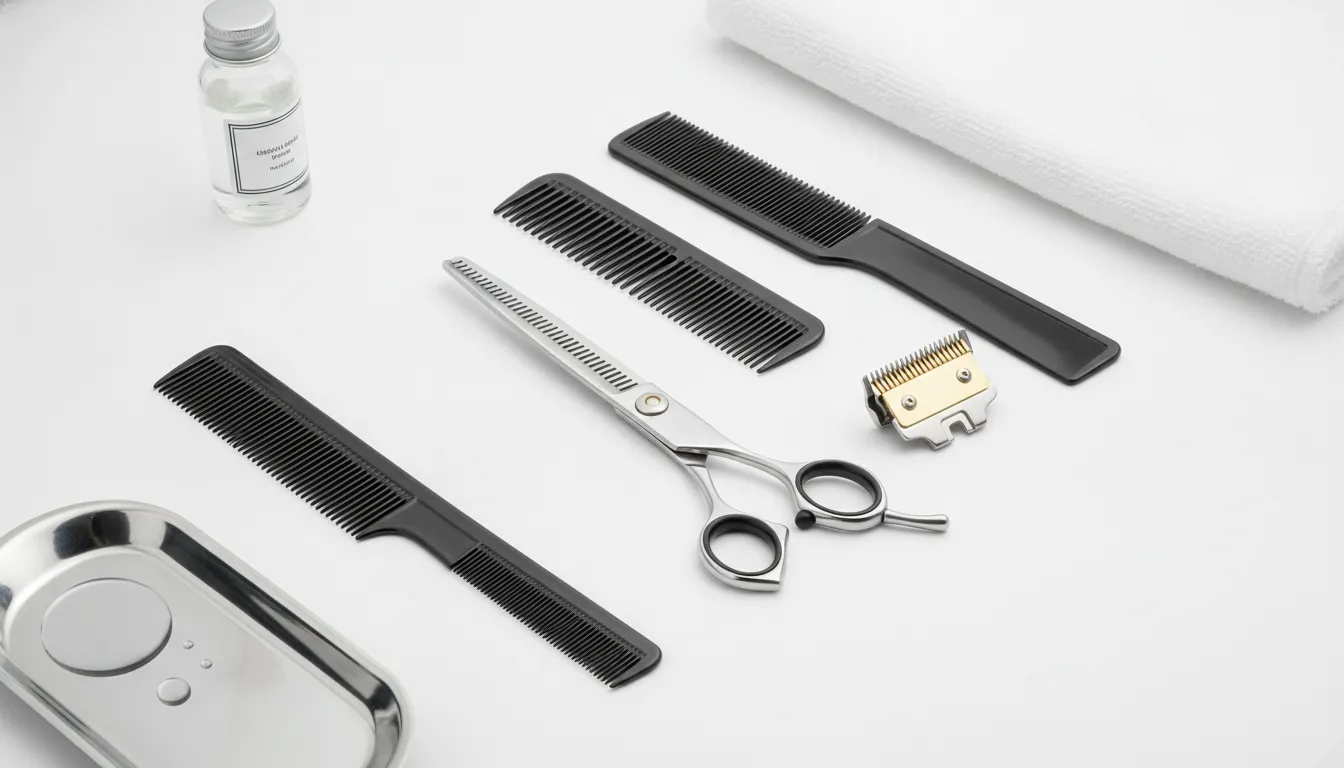
- Separate used tools immediately. Place tools that touched a client or became soiled in a container identified for dirty, soiled, or contaminated implements. Keep them away from clean tools and from the container used for disinfected equipment. This separation prevents a clean comb, shear, or blade from being handled as if it were ready for service.
- Remove visible hair and debris. Before applying a barber tool disinfectant, clear away hair, skin particles, and other visible soil. The California Board of Barbering and Cosmetology cites removal of visible debris as part of the required sequence for non-electrical implements: review the documented cleaning sequence.
- Clean the tool according to its material and design. Wash eligible non-electrical tools with soap or detergent and water when the label and tool allow it. Cleaning removes soil that can interfere with the next step. Electrical tools require more care because they must not be treated as immersion tools unless the manufacturer specifically permits that method.
- Choose the label-approved application method. Immerse only hard, nonporous tools that the disinfectant label identifies for immersion. For shears, clippers, and other electrical equipment, use a spray or wipe method only when both the disinfectant label and tool manufacturer support it. Do not improvise a soak for a powered tool or use a wipe as a substitute for a required immersion process.
- Apply enough product to meet the label directions. For immersion, cover every required surface. For a spray or wipe, follow the label’s coverage instructions and keep the tool in the required condition for the full contact time. There is no universal dwell time for every barber tool disinfectant. A time printed on one product label cannot be transferred to another product.
- Handle treated tools safely. Wear protective gloves or use clean tongs when removing implements from a disinfectant solution, particularly when the product label or workplace procedure calls for that protection. Avoid placing hands into a solution unnecessarily, and keep the container covered when the label or applicable regulation requires a covered setup.
- Rinse and dry only as directed. Some labels require thorough rinsing after treatment and air drying before reuse. Others may specify a different process. Follow the exact label for the product in use, then inspect the tool for residue, moisture, or remaining debris before it returns to service.
- Store the tool in a clean, covered location. Place fully processed tools in a clean receptacle or holder that can itself be disinfected. Keep clean implements covered and clearly separated from dirty equipment. If the solution becomes cloudy or contains debris, or if the label specifies a replacement schedule, change it according to those directions rather than extending its use.
For product-specific mixing or handling instructions, use the manufacturer-labeled container as the authority. A Barbicide use and mixing guide can provide context for that named product, but its directions should not be treated as a universal rule for every disinfectant.
Contact Time, Rinsing, Drying, and Storage Are Part of Disinfection
A barber tool disinfectant only works as directed when the surface stays wet for the required contact time. Afterward, tools must be rinsed, dried, and stored in a clean, protected place. Nevada rules and the product label control the sequence, so one solution’s timing or storage instructions cannot be borrowed for another.
Contact time means the entire treated surface remains wet for the period stated on the label. It is not the moment the tool enters the solution, and it is not the time required to complete a busy service. If a tool dries before the listed dwell time ends, follow the label’s directions for reapplication rather than assuming the process is complete. Nevada requires barber disinfectants to be used according to the manufacturer’s instructions, including the product’s application requirements: Nevada barber and cosmetology regulations.
For a named hydrogen-peroxide example, the EPA registration and PREempt Concentrate directions identify 4.25% hydrogen peroxide in the concentrate. The product sheet lists a 1:64 dilution for specified virucidal claims, while its barber-instrument directions use 1:16 and five minutes. Do not turn 1:64 into a universal barber-tool formula, and do not cite it as an instrument-immersion ratio unless the current label for your product says so. Keep the EPA label for EPA Reg. No. 74559-4 available so staff can verify the instructions instead of relying on memory.
After the PREempt instrument contact time, its product directions say to rinse instruments thoroughly and let them air dry before reuse. Other products may require a different process, so rinse and drying are never assumptions. Wet tools should not go directly into a storage pouch or clean holder, where trapped moisture can undermine a clean workflow. For metal tools, use the label’s handling instructions and avoid extending immersion beyond the stated time.
The disinfectant container also needs control. Keep an immersion solution covered when it is not being accessed, and replace it according to the manufacturer’s directions or sooner if it becomes cloudy or contains debris. The PREempt product sheet says to change its solution daily or when visibly dirty. That schedule is product-specific, just as its five-minute contact time and 1:16 instrument dilution are.
Once dry, place tools in a clean, covered storage area or receptacle that can itself be disinfected. Keep used tools separated from clean ones, and do not return disinfected implements to a contaminated holder. This final step protects the work completed by the barber tool disinfectant and keeps the next service from starting with cross-contamination.
What Mistakes Make Barber Tool Disinfection Less Reliable?
A barber tool disinfectant works only when the tool, solution, method, and timing match the product label. The most common failures are practical: disinfecting over visible debris, guessing dilution, removing tools too soon, using immersion on electrical equipment, or returning clean tools to a contaminated holder. A consistent check prevents each one.
Skipping pre-cleaning
Disinfection is not a substitute for cleaning. Hair, skin oils, product residue, and other visible debris can remain on a tool unless you remove them first. California regulations direct barbers to remove visible debris and clean non-electrical tools before disinfection. The EPA label for one approved product likewise says to pre-clean visibly soiled items. See the detailed guide to cleaning professional barber clippers for equipment-specific preparation.
Guessing dilution or borrowing directions
Do not estimate the concentrate-to-water ratio by eye, copy a ratio from another product, or rely on an unlabeled container. Dilution is product-specific. Keep the manufacturer-labeled container available, mix the solution exactly as directed, and check the label whenever a new product is opened. A product example may specify 1:64, but that direction belongs to that label, not every barber tool disinfectant.
Shortening contact time
Fast turnover does not change the required wet contact time. If the label says surfaces must remain visibly wet for a stated period, keep them wet for that entire period. Spraying and immediately wiping, allowing a solution to evaporate early, or removing an immersed tool too soon can leave the process incomplete. Never treat one product’s dwell time as a universal rule.
Using the wrong method on electric tools
Clippers and other electrical tools require a method approved for that equipment. Do not immerse an electric clipper or trimmer unless its manufacturer explicitly permits it. Regulations distinguish electrical implements and describe EPA-registered spray or wipe use for clippers, with the product label controlling the application. Keep liquid away from openings and follow the tool and disinfectant instructions together.
Cross-contaminating clean tools
A disinfected tool can become contaminated again through careless handling. Keep used implements in a separate dirty or soiled container. Remove treated tools with clean hands, gloves, or tongs as directed, then place them in a clean, covered storage area. Do not use a pouch, holder, or drawer that cannot itself be disinfected. Replace solution according to its label and when it becomes cloudy or contains debris. These controls are reflected in California’s barber sanitation requirements: tool disinfection and storage regulations.
Build a Practical Disinfectant Setup for a Las Vegas Barber Shop
A practical disinfectant setup matches the product and application method to each tool, follows the label, and gives clean tools a protected place to dry and wait for the next service. Las Vegas professionals can simplify that process with local product guidance, supply access, and equipment maintenance support from The Barber Company.
Start by listing the tools used at each station. Combs, brushes, shears, clipper blades, razors, and electrical tools may require different handling, so do not assume one solution or application method is suitable for everything. Bring the tool type, its material, and the disinfectant label to a knowledgeable supplier when you need help comparing options. The Barber Company serves professional barbers, shop owners, mobile barbers, students, and retail customers, so you can ask for practical guidance without needing to navigate a generic product aisle.
For a fixed shop, organize the setup around separate dirty-tool and clean-tool zones. Use a labeled disinfectant container or application area, along with covered storage for tools that have completed the required process. A professional barber station sanitation workflow can help shop owners make those zones consistent across stations. If you are opening or restocking a location, use the barbershop sanitation supplies guide to identify supporting equipment without turning this article into a general opening checklist.
Mobile barbers need the same separation and label discipline in a compact format. Plan where used tools go, how clean tools stay protected, and how supplies will be replenished between appointments. The guide to sanitation for mobile barber tools can help adapt the workflow to an on-location kit.
The Barber Company can also support the equipment around your disinfectant routine. Ask about wholesale barber supply in Las Vegas for professional supply planning, or contact the store at (702) 900-9972 for product guidance and local availability. When blades need care beyond cleaning and disinfection, use the professional blade sharpening service or ask about clipper repair service in Las Vegas. These pathways help keep sanitation and tool performance working together.
Want help matching a disinfectant to your tools? Call The Barber Company at (702) 900-9972.
Frequently Asked Questions
What is the best disinfectant for barbers?
There is no single best product for every tool. Choose an EPA-registered disinfectant whose label covers the implement and states the required bactericidal, virucidal, and fungicidal activity. In Nevada, barber implements must be disinfected according to the manufacturer label, so label compatibility and directions matter more than a generic brand ranking.
How do I clean and disinfect barber tools between clients?
Separate used tools, remove visible hair and debris, clean them, then apply the label-approved disinfection method. Maintain the label contact time, rinse and dry when directed, and place finished tools in a clean, protected container. Cleaning first is essential because disinfectant directions commonly require visibly soiled items to be pre-cleaned.
Can I use the same disinfectant method for clippers and shears?
Not necessarily. Nonporous combs, shears, blades, and similar implements may be eligible for immersion when the product label permits it. Electric clippers and trimmers require a method compatible with the tool, such as an approved spray or wipe process. Keep liquid away from electrical components and follow both the disinfectant and equipment instructions.
How long should barber tools stay wet during disinfection?
Use the exact contact time printed on the disinfectant label, and keep the surface visibly wet for that full period when required. Do not copy a ten-minute instruction from one product to another. For example, an EPA label may specify ten minutes for its own formulation, while another product can have different directions.
Ready to Choose the Right Disinfectant Setup?
The right disinfectant workflow depends on your tools, their materials, and the product label directions. The Barber Company can help you identify practical supplies, confirm local availability, and connect you with wholesale or technical maintenance support when needed.
Shop the Barbicide Concentrate Disinfectant product at The Barber Company for professional and retail tool-care needs.
Visit The Barber Company at 4700 Meadows Ln #110, Las Vegas, NV 89107, or call (702) 900-9972.
Follow @barbercompanylv on Instagram for updates from The Barber Company.
Call The Barber Company at (702) 900-9972 for barber tool disinfectant guidance.