
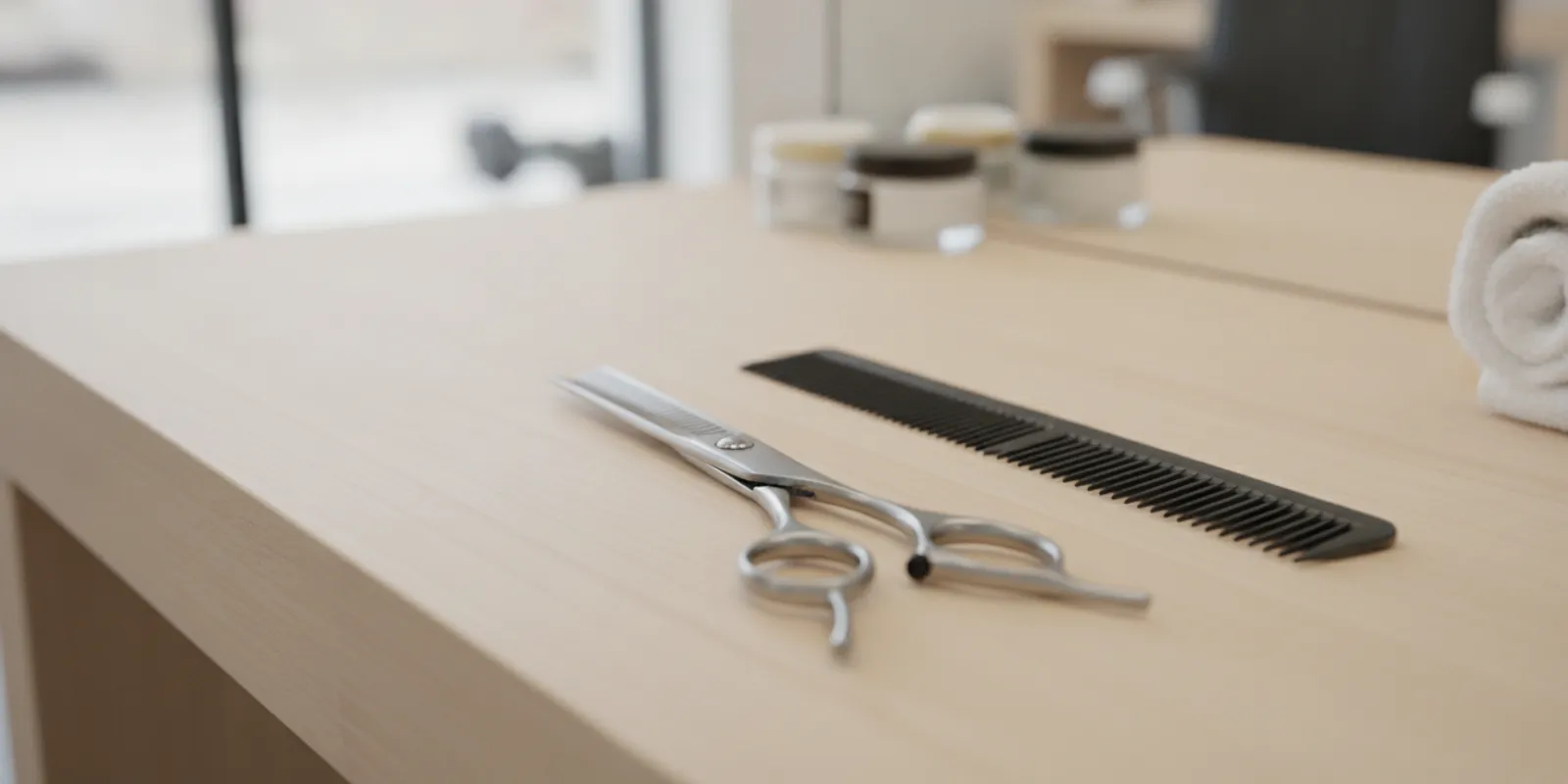
Thinning shears for barbers remove selected strands while leaving much of the surrounding length in place. Tooth count is one clue to how a pair may work, but it does not tell the whole story: tooth spacing, tooth shape, blade geometry, handling, and the section of hair all affect the result. The best comparison starts with the finish you need, then tests how consistently the tool removes bulk without leaving visible marks.
Ask The Barber Company about professional shears
What do thinning shears do in a haircut?
Thinning shears are designed to remove some hair from a section without cutting every strand across a solid line. They are often used to reduce density, soften a transition, or blend a shape that feels too heavy. The result depends on where the tool is placed and how much hair it captures, so the shears should support a clear plan rather than replace one.
A typical pair has a straight blade and a blade with teeth or notches. As the blades close, some strands pass between the teeth while others are cut. This selective action can leave more of the section’s length intact than a straight-bladed cut across the same area. It is not a guarantee of an invisible finish. A poorly chosen tool, an oversized section, or repeated cuts in one spot can create gaps, short pieces, or an uneven surface.
Barbers use thinning shears for different purposes: removing weight from dense areas, softening a transition between lengths, or reducing bulk that interferes with the outline of a style. These are not interchangeable tasks. Bulk removal calls for deliberate placement through the section; blending asks for a controlled transition; surface refinement calls for extra restraint because marks can be easy to see.
Before reaching for a pair, identify the problem in the haircut. Is the hair too dense in one area, is a transition abrupt, or is the silhouette too wide? Decide how much length should remain and where the change should begin and end. This diagnosis matters more than a headline tooth count. For a broader look at scissor selection, see The Barber Company’s guide to choosing professional barber shears.
How does tooth count affect texture control?
Tooth count describes the number of teeth along the toothed blade, but it is not a universal measure of how much hair a shear removes. Two shears with the same count can have different tooth widths, spacing, grooves, blade lengths, and cutting behavior. Treat the count as a comparison detail, then check the complete design and test the shear on a controlled section before using it on a finished style.
In general, a design with more, closely spaced teeth can distribute the cutting action across more contact points. A design with fewer or wider-spaced teeth may engage a more distinct portion of the section with each closure. Those descriptions are starting points, not performance promises. The exact effect varies by the tool’s construction and by the hair placed between its blades.
Look at three details together:
- Tooth count: Note the stated number, but do not assume it predicts a removal percentage.
- Spacing and tooth profile: Compare how far apart the teeth sit and whether their shape appears suited to the kind of engagement you want.
- Blade length and handling: Consider how the shear fits your hand and reaches the area you intend to work.
A product description may use terms such as texturizing or blending, but labels alone do not establish how a shear will behave in your hands. When comparing options, ask whether the manufacturer describes a specific use and whether the specifications are available. The Barber Company carries Utsumi shears; review the available product details or ask for help matching a tool to the work you do.
Also distinguish between a tool designed for selective removal and one intended for a different cutting action. The teeth are part of the working edge, not a shortcut to a predictable percentage. If the listing does not provide a removal rate, do not invent one based on tooth count. Compare the shears by construction, hand feel, and a repeatable test instead.
Which tooth count should you choose?
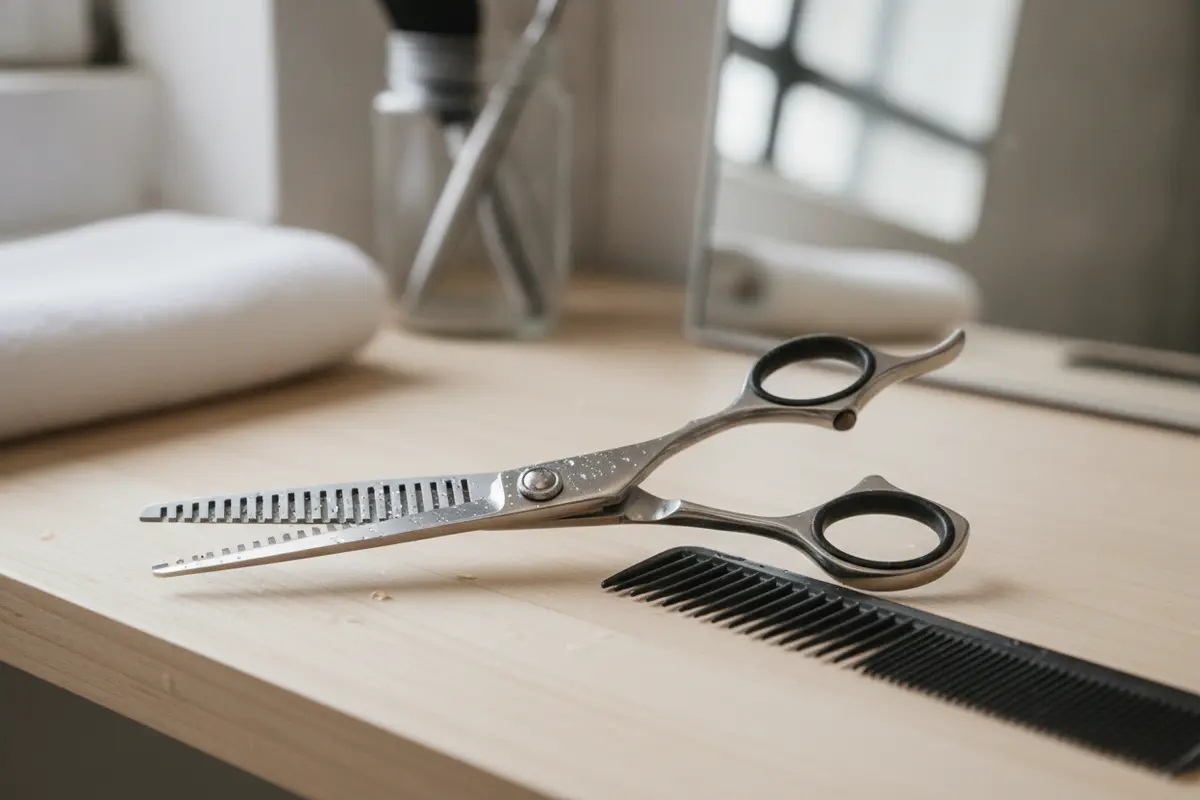
Choose tooth count by matching the shear to a task, not by looking for one number that works for every haircut. A barber who needs to remove visible bulk from dense sections may prefer a different cutting feel from someone who is softening a transition or making a subtle surface adjustment. Because count alone cannot predict the result, use it to narrow a comparison, then verify the tool with a controlled test.
Start with the most common work the shear will perform. Write down whether the priority is bulk reduction, blending, or light refinement. Then compare candidate shears with the same kind of hair, section size, and closure. Look at the change after each pass. If a tool removes more than you can comfortably control, it may be a poor match for delicate blending, even if its specifications seem appealing.
| Work goal | What to compare | How to test the result |
|---|---|---|
| Reduce bulk in a dense area | Tooth spacing, engagement, blade length, and hand control | Use a small, consistent section and check how much weight is removed after one closure. |
| Soften a transition | How evenly the shear blends and whether the cut leaves visible separation | Work in a discreet section, comb through, and inspect the transition from more than one angle. |
| Refine a surface or outline | Precision, predictable closure, and the ability to avoid neighboring hair | Take a minimal test pass away from the most visible area, then assess the shape before continuing. |
| General shop use | Comfort, balance, maintenance needs, and suitability for the barber’s regular services | Repeat the same test on a representative section and compare control as well as finish. |
Do not treat a higher or lower count as automatically better. The right tool is the one that performs the intended job consistently and gives you enough control to stop when the shape is right. If you cannot test a shear before buying, ask for the product specifications and clarify its intended use. Avoid choosing from a number in isolation.
For a well-rounded station, compare the thinning shear with your primary cutting shears rather than expecting one tool to cover every task. The Barber Company’s overview of essential barber tools can help you think through the wider setup, while the brand directory is a useful starting point for exploring available makers.
How can you compare shears before buying?
A fair comparison keeps the test conditions steady. Use the same hair type, section size, starting condition, and number of closures for each candidate. Comb the section into the same position, make one deliberate closure, then inspect the result before repeating. This makes it easier to notice differences in control and finish instead of confusing a change in technique with a change in tool.
- Define the task. Identify whether you need bulk reduction, blending, or light refinement. Avoid testing several goals at once.
- Review the specifications. Record tooth count, blade length, design details, and any maker guidance. If a detail is not provided, ask rather than infer it.
- Check the fit. Hold the shear in your working hand. Note whether the grip feels stable and whether you can open and close the blades smoothly without forcing the motion.
- Use a repeatable section. Choose a discreet, representative section and keep its size consistent for each test.
- Inspect after one pass. Comb the section out and view it from different angles. Look for abrupt gaps, uneven weight, or strands left standing apart from the surrounding shape.
- Repeat only when justified. Add another pass only if the first result supports it. Record what changed so the comparison remains useful.
Do not judge only by how much hair comes away. A shear that removes aggressively can be difficult to use for subtle work; a controlled result that takes a measured sequence may better suit the intended finish. Consider comfort across repeated openings and closings, especially if the shear will be used during a full day of appointments.
When trying a tool in a shop, use a clean test method and follow the shop’s hygiene practices. If no test is available, seek exact specifications and guidance on the tool’s purpose. You can contact The Barber Company with questions about available shear options. For local shopping and other equipment, browse barber supplies in Las Vegas.
Technique makes the tooth count useful
Even a well-matched shear can create an uneven finish when it is used without a plan. Work with clean sections, keep the tool placement intentional, and check the result frequently. The aim is not to remove as much hair as possible; it is to make a specific adjustment while preserving the silhouette and the movement the client wants.
Begin by combing the hair into its natural fall or the position used for the finished style. Separate a small section so you can see its density and direction. Decide where the weight should change. Place the shears only in the area that needs adjustment, close them with a controlled motion, and then release the section to assess the shape.
- For bulk reduction: Work within the dense area rather than cutting indiscriminately across the visible surface. Recheck the section after each pass.
- For blending: Keep the transition area in view. Avoid stacking repeated closures at one level, which can make the change appear abrupt.
- For refinement: Use restraint. A small change can have a visible effect around an outline or on a finer section.
- For longer or curly hair: Account for how the hair falls and expands when released. Inspect it in its natural position before deciding whether more removal is needed.
Do not close the shears repeatedly through the same section without checking the result. That can compound the removal and make it hard to identify which pass created an unwanted gap. Comb the hair out, compare both sides when symmetry matters, and make adjustments in small increments.
These shears are a finishing and shaping tool, not a substitute for choosing the right sectioning and cutting approach. If the form is already uneven, thinning may expose the imbalance rather than correct it. Step back, assess the overall outline, and decide whether the underlying length or shape needs attention first.
Hair condition and growth pattern also influence the visible finish. A dense section can conceal the effect of a pass until it is combed into place, while a finer area may show a change immediately. Consider how the hair will sit when dry and styled, not only how it looks while held between your fingers. If the client wears the hair in more than one direction, check the transition in those positions as well.
Use a sequence that makes the adjustment easy to evaluate: establish the main shape first, identify the exact area that feels too heavy, then make a small change and reassess. Do not thin broadly just because one part of the cut feels dense. Keep the work localized, and compare the affected area with the surrounding hair. When the desired shape appears, stop. Additional passes without a clear reason can make the result harder to balance.
Communication helps set a sensible limit. Ask what the client wants to change and explain that removing hair is not instantly reversible. For a first visit or an unfamiliar hair pattern, a conservative approach gives you a chance to evaluate how the hair responds before making a larger adjustment. The final decision should be guided by the desired style and the hair in front of you, not by a preset number of closures.
Barbers building a complete station can also use The Barber Company’s barbershop equipment checklist to review the wider tool setup and its practical role during a service.
What should you check for comfort and control?
Control depends on more than the shear’s specifications. The handle should allow a secure working grip, the blades should move smoothly, and the tool should feel manageable in the positions you use most. A shear that causes awkward hand movement can undermine precision, so assess comfort during deliberate openings and closures before committing to a particular design.
Consider how the shear feels with your regular cutting posture. Can you maintain a steady grip without squeezing hard? Does the tool open and close without catching? Can you guide it into the target area while keeping neighboring hair out of the blades? These practical checks matter more than a design that looks impressive in a product photo.
Ask about details that affect fit and use, including overall length, handle configuration, care instructions, and the maker’s intended use. Do not assume that every shear with a similar tooth count will handle the same way. If a listing is missing information, request it from the seller or manufacturer before making a decision.
Consider whether the shear is for a single specialty task or routine use across many services. A dedicated tool can make sense when its job is clear, while a general-use choice should be especially predictable and comfortable. Keep the intended role in mind when comparing cost and maintenance requirements, but do not infer durability or service life from price alone.
For organization, a designated place for each tool helps keep the station orderly and makes it easier to notice when a shear needs cleaning or service. See the barber station organization guide for practical ideas on keeping frequently used equipment accessible without crowding the work area.
Care and maintenance protect cutting performance
Thinning shears need routine care just like other precision cutting tools. Clean and dry them according to the manufacturer’s instructions, keep them stored safely, and avoid using them for tasks they were not designed to perform. If the blades feel rough, fail to close cleanly, or produce an inconsistent cut, stop and inspect the tool instead of compensating with extra force.
After use, remove hair and residue with an appropriate method for the tool. Follow the maker’s guidance for cleaning and lubrication; do not assume that every product or technique suits every shear. Store the blades closed in a protective case or a designated secure space where they will not collide with other metal tools or be dropped.
Look for changes in operation: a rough or sticky motion, visible damage, looseness, or a cut that no longer feels consistent. These signs do not prove a particular part has failed, but they are reasons to stop using the shear until it has been assessed. Avoid forcing the blades together or attempting a complex adjustment without the right training and tools.
Shears require care appropriate to their construction. Clipper blade sharpening information is not automatically applicable to shear edges, and a general sharpening method can damage a precision tool. For relevant service context, see The Barber Company’s shear sharpening service guide and signs that shears may need professional attention. Ask what service is suitable for your specific shear before arranging work.
Keep product instructions with the tool when possible. Note the date and nature of any service, and compare the shear’s performance after it returns with the way it performed before. Consistent care helps you detect a change early, but no maintenance schedule can guarantee a particular service life or outcome.
Choosing for a professional shop or home use
Professional barbers and home users can apply the same basic selection logic, but their priorities may differ. A working barber may value predictable handling across repeated services and access to product guidance. A home user may need a tool suited to occasional, clearly defined use and straightforward care. In both cases, match the shear to the task rather than buying based on a tooth count alone.
For a busy station, consider whether the tool fits your regular services, hand position, and maintenance routine. If several barbers share equipment, clear storage and consistent care practices help everyone recognize the condition of the tool. Shop owners building or updating a station can review The Barber Company’s wholesale barber supply information and ask directly about account options and product availability.
For personal use, be realistic about experience and the type of haircut you plan to maintain. Thinning shears are not a shortcut to correcting an uneven cut, and removing too much can take time to grow out. If you are unsure how to use them safely or how much to remove, consult a trained barber rather than making several unmeasured passes at home.
The Barber Company serves professional barbers as well as the general public, so a professional license is not required to shop for retail products. Readers nearby can review local delivery information for eligible Las Vegas valley orders, or visit the The Barber Company store to explore available supplies. Confirm current product availability and delivery details directly with the business.
Make a practical choice, not a promise
The most useful shear is not necessarily the one with the most teeth, the fewest teeth, or the boldest product description. It is the one whose design and handling suit the haircut task, whose behavior you can assess, and whose maintenance needs fit your routine. Tooth count helps organize a comparison; a careful test shows whether the tool gives you the control you need.
Before you buy, name the job the shear will do, compare full product specifications, check comfort, and test a representative section when possible. During a haircut, work in small increments and inspect the released hair before continuing. If performance changes, pause and arrange an appropriate assessment rather than forcing the tool through the service.
For professional product guidance, the Professional Beauty Association provides broader industry resources. For product availability or local assistance, contact The Barber Company and explain the kind of work you need the shear to perform.
Call The Barber Company at (702) 900-9972 about shears and supplies
Frequently Asked Questions
Use these quick answers as a starting point when comparing thinning shears. The right selection still depends on the specific tool, the haircut goal, and how the shear behaves in a controlled test. When product details are unclear, ask for the maker’s specifications instead of assuming tooth count determines performance.
Do more teeth always remove less hair?
No. Tooth count alone does not establish how much hair a shear removes. Tooth shape, spacing, blade design, section size, and technique all affect the result. Compare the full specifications and test the shear with consistent conditions.
Can one pair of thinning shears do every texturizing job?
One pair may suit several tasks, but it may not offer the same control for bulk reduction, blending, and fine refinement. Choose based on your most common work, then check whether the shear performs other tasks predictably before relying on it for them.
How can I avoid removing too much?
Start with a small, discreet section and one controlled closure. Comb the hair out and inspect the shape before making another pass. Avoid repeating cuts in the same spot without checking the result, and step back if the underlying form needs correction.
When should thinning shears be serviced?
Seek an assessment if the blades feel rough, show visible damage, do not close smoothly, or produce an inconsistent cut. Follow the maker’s care instructions, and do not try to correct a precision shear with a sharpening method intended for a different tool.
Visit The Barber Company
The Barber Company offers professional barber supplies and serves both working barbers and retail customers. Check the store or contact the team to confirm available products, ask about local delivery, or get help finding the right path for your equipment needs.
Visit The Barber Company online store or follow The Barber Company on Instagram. The business address is 4700 Meadows Ln #110, Las Vegas, NV 89107. Call (702) 900-9972 for assistance.
Compare shears by the work you need them to do, and choose the tool that gives you consistent, controlled results.