
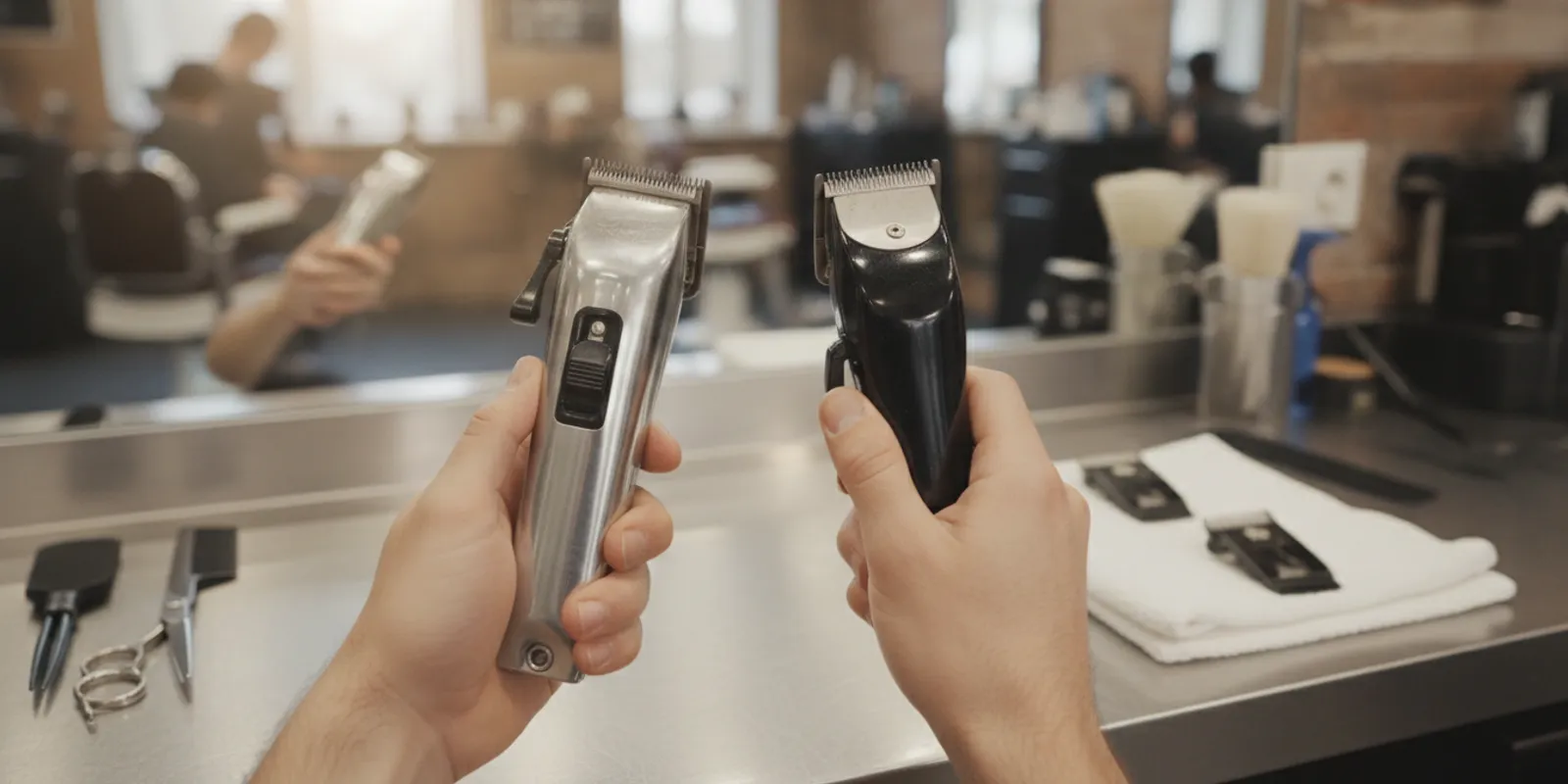
Adjustable vs detachable blade clippers are not simply two versions of the same tool. An adjustable clipper changes its cutting range through a built-in lever or blade adjustment, while a detachable clipper uses removable blade sets that can be exchanged for different cutting lengths. The right choice depends on how you cut, how often you change blades, and how you want to organize your station.
Ask The Barber Company about choosing your clipper setup
What is the difference between adjustable and detachable blade clippers?
An adjustable clipper keeps its blade assembly in place and changes the cutting position with a lever or other adjustment built into the clipper. A detachable clipper lets you remove the blade assembly and install another blade set. One gives you quick, on-tool range changes; the other makes blade swapping a central part of the workflow.
The terms describe how you change the cutting setup, not a complete performance ranking. An adjustable clipper is often chosen for blending, fading, and moving between close and longer positions without setting down the tool. A detachable clipper is often chosen when a barber wants to switch among separate blade sizes or styles during a service.
There are model differences within both groups. Lever travel, blade compatibility, cutting geometry, motor design, weight, battery configuration, and available replacement parts vary by manufacturer and model. Before buying, check the specific tool’s manual and product specifications rather than assuming that every clipper in a category behaves alike.
If you are exploring available models, start with The Barber Company’s professional hair clipper selection and compare the individual product details in person or with the store team.
How does each blade system work in a barber’s hand?
With an adjustable clipper, the blade stays mounted while a lever shifts its position through the model’s designed range. This makes it practical to change the cut while maintaining your grip and continuing a fade or blend. With a detachable clipper, the barber releases one blade assembly and fits another, changing the actual blade set rather than moving a lever.
An adjustable lever is a workflow control, not a substitute for understanding guards and technique. The lever can help make small transitions, but the result still depends on angle, pressure, overlap, hair type, and the clipper’s blade condition. Learn the feel and range of your particular model before relying on it for close work.
Detachable blades make the blade itself a modular component. A barber can prepare the blade sets needed for a service, change them as the work calls for it, and keep compatible spares available. That convenience comes with a need to track which blade is installed, keep sets protected, and confirm compatibility with the clipper body.
Some clippers use a built-in adjustable system; others accept specific detachable assemblies. Do not assume a detachable blade fits every clipper or that a replacement blade has the same cutting behavior as another model’s. Confirm fit and intended use from the manufacturer’s specifications.
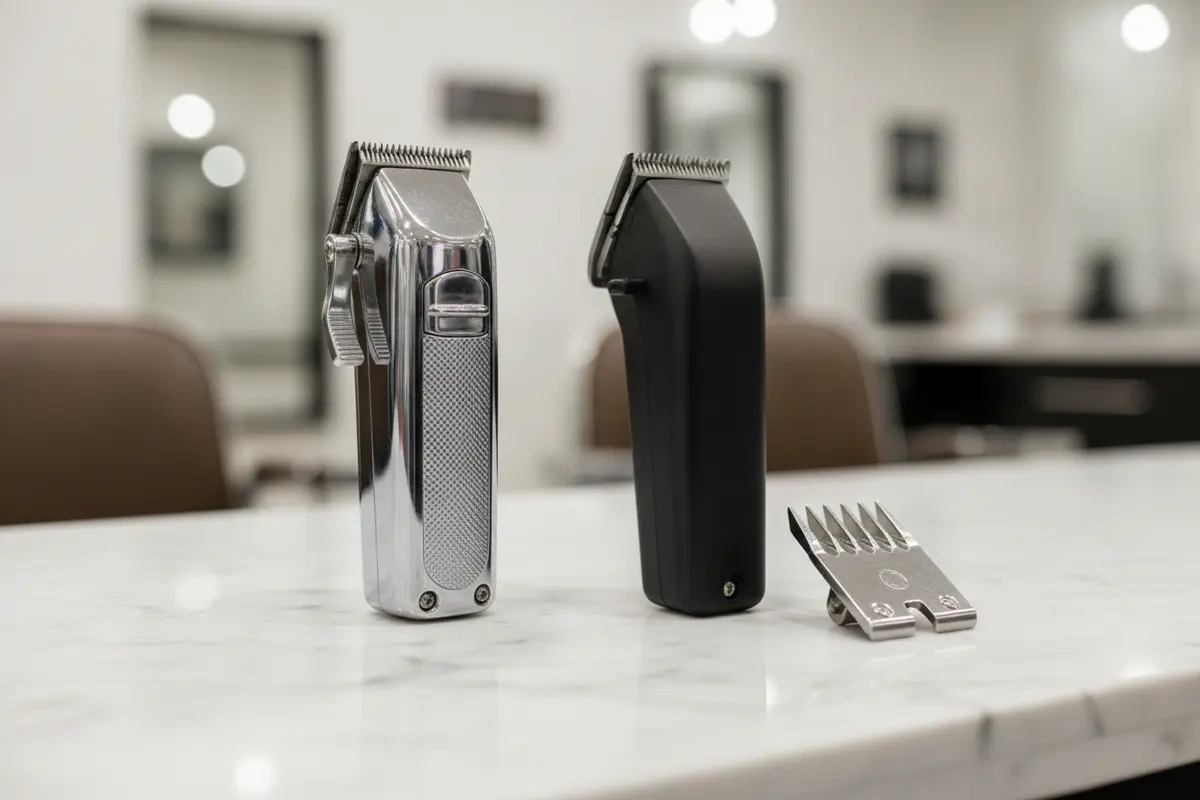
Adjustable vs detachable blade clippers at a glance
Compare the systems by what you actually change during a cut. Adjustable models change blade position on the tool, while detachable models change blade assemblies. The table summarizes common workflow differences; it is a starting point, not a promise that every model shares identical specifications or results.
| Consideration | Adjustable-blade clipper | Detachable-blade clipper |
|---|---|---|
| How the setup changes | Move the clipper’s lever or built-in adjustment while the blade remains installed. | Remove the installed blade assembly and attach a compatible alternative. |
| Typical workflow strength | Fast position changes while fading, tapering, or blending. | Direct changes among prepared blade sets for different cutting tasks. |
| What to plan for | Learn the lever’s feel and range; select compatible guards and replacement parts. | Organize, protect, clean, and track compatible blade sets and their use. |
| Station needs | Room for the clipper, guards, and regular care supplies. | Room for the clipper plus a safe, organized place for extra blade sets. |
| Best decision test | Does the service call for repeated adjustment without changing blade assemblies? | Will swapping separate blade assemblies make the work or tool rotation more practical? |
| Before purchase | Check model-specific blade, guard, motor, and adjustment details. | Verify blade-to-clipper compatibility and availability of the blade sets you need. |
Neither column guarantees a closer cut, cooler operation, longer life, or faster service. Those are model-specific outcomes affected by design, maintenance, technique, and working conditions. Compare the actual product specifications and try the tool’s balance and controls if you can.
When does an adjustable clipper make more sense?
An adjustable clipper is a strong fit when your work involves frequent transitions and you want to change the blade position without removing the blade assembly. The lever gives you an immediate control to work into fades and tapers. It may also suit a compact station where carrying several blade assemblies is not part of your routine.
For a barber who moves between close and longer positions in a single service, a lever can make those transitions feel straightforward. You can keep the clipper in hand, make a controlled change, and continue working. That does not eliminate the need for guards or careful blending; it simply changes how you access the clipper’s available positions.
Adjustable models can also make sense for a newer barber who wants one familiar tool to practice transitions. A simple station does not need to mean a limited skill set: technique, guard choice, blade condition, and control matter more than collecting tools. Choose a model with controls you can operate comfortably and maintain consistently.
Think carefully if you prefer a fixed, repeatable setup for particular tasks, or if you routinely want to change the complete blade assembly. In those cases, a detachable system may map more naturally to the way you organize your work. A lever-based tool can still be useful, but it may not match your preferred sequence.
The Barber Company carries professional brands such as Wahl, Andis, Gamma+, Stylecraft, and BaByliss Pro. Browse by brand, then verify whether a specific model has an adjustable or detachable setup and which accessories it supports.
When is a detachable-blade clipper the better fit?
A detachable clipper can suit barbers who prefer to move among separate blade assemblies instead of relying mainly on a lever. It is useful to consider when you plan blade options around distinct tasks, keep spare sets on hand, or want to change the blade assembly as part of an established cutting sequence. Model and blade compatibility remain essential.
Detachable systems can make a planned workflow feel organized: select the sets needed for the appointment, keep them in a designated place, and change them when the service calls for it. In a busy shop, a repeatable setup can help each barber know which assembly is installed. A clear storage routine also helps prevent a loose blade from being damaged or misplaced.
The tradeoff is that extra blade sets require attention. You need to keep compatible pieces identified and in good condition, and you should follow the manufacturer’s instructions for removal, cleaning, maintenance, and installation. A detachable system is not automatically faster if blades are scattered or if the barber has to pause to find the right set.
For a mobile barber, the question is not only which system cuts well. It is also whether the kit can safely carry the clipper and any additional blade assemblies without adding unnecessary clutter. A mobile setup benefits from deliberate packing, protected storage, and knowing which compatible components are essential for the services booked.
Review The Barber Company’s professional clipper and tool brands as a starting point, and ask about the specific models and blade options currently available. Do not buy a detachable blade based on appearance alone; confirm that the model is designed to accept it.
Which system fits fades, tapers, and detail work?
Either system can support professional cutting when the clipper is suited to the task and the barber controls the technique. Adjustable tools offer convenient position changes during a blend. Detachable tools offer a way to change blade assemblies. The best match depends on the specific cut, your preferred sequence, compatible guards or blades, and the tool’s handling.
For a fade, consider whether you make many small transitions while keeping one clipper in hand. If so, the adjustable lever may fit the rhythm of your work. If you prefer to select a blade set for a defined stage or task, a detachable design may better match your sequence. Neither choice removes the need to work gradually and inspect the blend under good light.
For tapers, focus on control and repeatability. A lever’s settings should feel easy to distinguish and return to. With detachable blades, set out the compatible assemblies you intend to use and keep their identities clear. In either case, a worn or poorly maintained blade can interfere with the result, so evaluate the cutting edge and clipper condition rather than blaming the system category.
For detail work near the hairline or around the ear, choose a tool designed for that job and use its instructions. Do not assume that a main clipper’s shortest setting is appropriate for every detail task. A separate trimmer may be the right complement. Read the guide to trimmers for barbers if you are deciding whether a dedicated detail tool belongs in your setup.
Zero gapping is a separate blade adjustment, not a synonym for choosing adjustable versus detachable. It affects how close the blade edges are set and should be approached with care because an overly aggressive setup can irritate or cut skin. For service options and context, see The Barber Company’s clipper zero-gapping service in Las Vegas and its guide to zero-gapping clippers.
What should you check before choosing a clipper?
Start with the model, not the category label. Confirm the clipper’s intended use, blade type, compatible guards or blade assemblies, control layout, weight, power configuration, and care instructions. Then compare those details with the services you perform and the station or travel kit you actually use.
Map your most common service
Write down the work the clipper must handle most often: full cuts, fades, tapers, bulk removal, or touch-ups. Note when you change positions or tools. If you rely on repeated lever changes, an adjustable model may feel natural. If you switch blade assemblies for planned stages, consider a detachable system. Let observed workflow guide the choice rather than a general claim that one type is superior.
Check fit, control, and comfort
Where possible, hold the clipper as you would during a service. Consider grip, balance, switch placement, lever reach, and whether the weight feels manageable over a full day. For a detachable design, consider the blade release and how confidently you can handle the assembly. Ask which replacement components and accessories match the exact model.
Plan for upkeep and parts
Every clipper needs routine care. Follow the model’s manual for cleaning, lubrication, blade installation, and any restrictions on products or methods. An adjustable clipper still has a blade that needs attention; detachable assemblies still need proper handling and care. If the tool begins pulling hair, making an unusual sound, or cutting unevenly, stop and diagnose it instead of continuing to force the cut.
For routine care, compare the practical steps in the barber clipper maintenance guide, the instructions on oiling clipper blades, and the site’s guide to cleaning professional barber clippers. Follow manufacturer directions and applicable shop procedures; cleaning and disinfection are not interchangeable tasks.
Estimate the complete setup
Compare more than the clipper’s purchase price. Account for compatible guards or blade sets, a safe storage solution, replacement components, and the time you will spend organizing and maintaining them. Costs and availability depend on model and current stock, so contact the store for current details rather than relying on a generic price estimate.
Ask about repair support before a tool fails
A clipper is part of your working kit, so know where to turn if it needs attention. The Barber Company offers technical services that include clipper repair, blade sharpening, and zero gapping. Review the in-store clipper repair service and repair inquiry form for the appropriate next step; ask whether your particular issue and model can be serviced.
How can you make either setup work reliably?
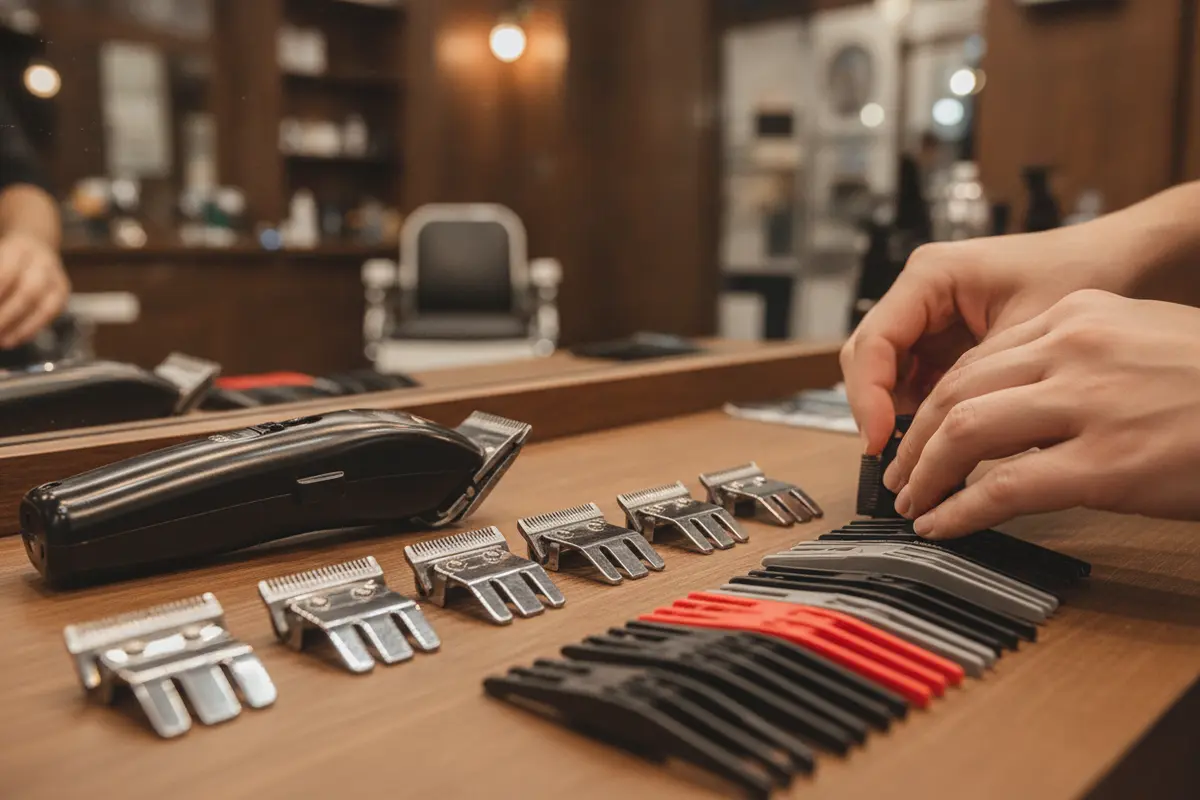
A reliable clipper routine starts with a consistent station layout, clean tool handling, and attention to changes in cutting behavior. Adjustable and detachable systems need different organization, but both benefit from a designated place for tools, compatible accessories, and maintenance supplies. Build a routine your team can repeat rather than relying on memory during a busy shift.
For adjustable clippers, return the lever to a known position when you finish and keep compatible guards organized. If a lever feels loose, sticks, or no longer moves as expected, consult the manual or arrange service rather than forcing it. A setting that is familiar to one barber may not be obvious to another, so share a consistent handling routine at a shared station.
For detachable clippers, assign each blade assembly a protected, identifiable place. Confirm the correct blade is installed before starting work, and do not leave assemblies loose where they can be knocked onto the floor. If several barbers share a station, agree on where clean, ready-to-use components belong and where used tools go pending the shop’s cleaning process.
For both types, inspect the blade and clipper before the first service of the day and between clients according to the manufacturer’s instructions and shop procedures. A change in sound, heat, cutting feel, or hair feeding can be a reason to pause and check the tool. Do not infer that a blade needs sharpening solely from its category; inspect condition and seek qualified help when needed.
Barbers working across the Las Vegas valley can check the store’s local delivery information when replenishing supplies. The company states that free local delivery is available on orders over $50 throughout the valley; confirm current delivery details and eligible areas with the store. For professional wholesale options, see wholesale barber supplies in Las Vegas.
Which clipper type should you choose?
Choose an adjustable clipper if quick lever changes match the way you fade, taper, and blend. Choose a detachable model if separate blade assemblies fit your planned workflow and you are ready to manage compatible sets. If you are undecided, handle the exact models, compare their specifications, and weigh the upkeep and accessory needs alongside cutting style.
A practical decision checklist can keep the comparison grounded:
- Choose adjustable when: you value on-tool position changes and want a straightforward setup for blending transitions.
- Consider detachable when: you prefer separate blade assemblies for defined tasks and can keep them organized and protected.
- Check either way: model-specific blade compatibility, guards, replacement parts, ergonomics, care directions, and repair support.
- Do not decide by label alone: motor, blade, weight, and power specifications vary between models within each category.
The Barber Company serves both professional barbers and retail customers, and no professional license is required to shop. You can review its about page to learn about the business, then ask the team which current models suit your needs. Spanish-language assistance is also available; HABLAMOS ESPAÑOL.
How should a shop plan its clipper lineup?
A shop lineup does not need one clipper type for every barber or service. Start by mapping the tools already in use, the tasks they handle, and the gaps that cause delays. Then decide whether another adjustable clipper, a detachable model, or a complementary trimmer addresses a real workflow need.
For a solo barber, begin with the core tool used through most appointments. If one adjustable clipper already covers your fades and tapers comfortably, a second tool might be more valuable as a backup than as a duplicate with a different label. If the recurring slowdown is changing among distinct blade assemblies, a detachable setup may fill a specific gap. Match a new purchase to an observed bottleneck.
For a multi-chair shop, consistency can matter as much as individual preference. Ask each barber to identify their primary tool, compatible accessories, and any service that requires a different blade setup. The goal is not to force everyone into one system. It is to avoid buying incompatible blades, duplicating seldom-used accessories, or leaving a chair without a dependable working clipper.
Make a simple inventory record with the manufacturer, exact model, blade system, compatible guards or assemblies, and a note about where replacement parts are sourced. This is especially useful when a shop has tools from several brands. A model number on a purchase record helps staff check compatibility later rather than relying on memory or a product’s general category name.
Consider how tools move through the shop as well. If clippers are shared, set a consistent process for identifying the tool, checking its condition, and sending it for care or repair. Separate personal preference from a safety or maintenance issue: a barber may prefer one lever feel, while every user should follow the same handling and cleaning procedures required by the shop and manufacturer.
Students and newer barbers can also learn from a deliberately small lineup. Practice the adjustment range and guard transitions on one familiar system before adding more hardware. Once you know what the tool cannot do comfortably, you can make a more informed case for a second clipper or a different blade system. This avoids confusing tool variety with technical progress.
What mistakes make this comparison misleading?
Category labels are useful only when they lead to a model-specific comparison. A fair choice considers the actual clipper, its blade, the accessories it accepts, and the way it feels in your hand. Avoid conclusions based on one feature or another barber’s preference without checking whether your service mix and working routine are similar.
- Comparing a category to a single model: Adjustable and detachable describe broad mechanisms. Compare named models and specifications rather than treating either group as uniform.
- Assuming a lever means a particular cut length: The available range is model-dependent. Check its documentation and use the appropriate guards and technique.
- Buying blades before confirming fit: Confirm compatibility with the clipper’s exact model and the intended blade assembly before ordering.
- Ignoring the complete kit: Extra assemblies need safe storage and care; guards and replacement parts also affect the practicality of the setup.
- Expecting the tool to replace technique: A lever or blade swap does not blend a fade on its own. Control, sectioning, overlap, and inspection remain the barber’s work.
- Continuing with a tool that behaves differently: Pulling, unusual sound, or uneven cutting can signal a condition that deserves attention. Pause, check the manual, and seek service when appropriate.
Also avoid treating all blade adjustments as interchangeable. Using an adjustment mechanism, replacing a blade assembly, aligning a blade, and sharpening a blade are different tasks. If you are unsure which issue you are seeing, describe the model and symptoms when asking for help. A clear diagnosis is more useful than ordering a component based on a guess.
Finally, don’t choose based only on a generalized claim about speed, power, runtime, or longevity. These specifications vary by model and should be checked against manufacturer information. Think through your own appointments: count the changes you actually make, note the tools you reach for, and decide whether the current setup slows you down or produces a result you cannot achieve reliably.
Contact The Barber Company to compare clipper models and blade options
Frequently Asked Questions
The short answer is that neither blade system is best for every barber. Use your service mix and workflow as the guide, then check compatibility and care requirements for the exact model. These answers cover common questions that come up when comparing adjustable and detachable clippers.
Are adjustable clippers better for fades?
They can be convenient for fades because the lever lets you change the blade position while the blade stays installed. A detachable clipper can also work for fades if its blade options and your technique suit the service. Skill, blade condition, guard choice, and model design matter more than the category name.
Can detachable blades fit any clipper?
No. Compatibility depends on the clipper and blade design. Check the manufacturer’s specifications for the exact model before buying a replacement or additional blade assembly. A blade that looks similar is not necessarily designed to fit or perform correctly with your clipper.
Is an adjustable clipper the same as a zero-gapped clipper?
No. Adjustable describes a clipper’s built-in way to change blade position. Zero gapping refers to a blade alignment adjustment intended to bring cutting edges closer together. It is a separate setup decision and should be handled cautiously to reduce the risk of skin irritation or cuts.
Which type is easier to maintain?
Neither type is maintenance-free. Both need care according to the manufacturer’s manual. Adjustable clippers require attention to the installed blade and adjustment mechanism. Detachable systems add blade assemblies to organize and maintain. The easier routine is the one you can follow consistently with your station, tools, and shop procedures.
Where can Las Vegas barbers get clipper help?
The Barber Company provides in-store technical services including clipper repair, blade sharpening, and zero gapping. Contact the store before bringing in a tool to ask about the model, issue, and service process. You can also browse clipper options and ask about wholesale purchasing if you operate a professional shop.
Visit or contact The Barber Company
The Barber Company is a local wholesale and retail barber supply business for professionals and the public. Check the store’s current contact details before visiting, and ask the team about product availability, technical service, or wholesale options. The team can also help you narrow down compatible clipper models and accessories for your working routine.
Browse the The Barber Company store, follow the business on Instagram at @barbercompanylv, or call (702) 900-9972. The listed address is 4700 Meadows Ln #110, Las Vegas, NV 89107.
For a narrow trade-classification reference, the U.S. International Trade Commission’s Harmonized Tariff Schedule search lists shavers, hair clippers, and cutting heads in an appliance classification; that listing is not a guide to clipper performance or blade compatibility. View the USITC Harmonized Tariff Schedule search result.
Match the clipper system to the way you work, confirm the exact model’s specifications, and keep its maintenance routine consistent.