

.
Small barbershop does not need a crowded floor to deliver a polished service. It needs a workstation plan that keeps the mirror readable, essential tools accessible, cords controlled, and the walking path clear around each chair. In a compact room, every placement affects movement, client comfort, sanitation, and how easily the next service begins.
Quick answer: A practical barber workstation setup gives each tool, supply, mirror, and power point a deliberate role while preserving a clear service path. Start with the chair and client sightline, then assign primary reach items, reserve storage, and cleaning supplies around the way the barber actually works.
The best layout is not necessarily the most decorative one. It is the arrangement that reduces repeated reaching and makes the space easy to reset between clients. Begin by mapping the service workflow, then use that sequence to choose the mirror position, storage pattern, and compact layout that fit your shop.
Need help planning your barber workstation setup? Call The Barber Company at (702) 900-9972.
How to Plan a Barber Workstation Setup in a Small Shop
A barber workstation setup connects the chair, mirror, tools, storage, power, and walking path. Together, these elements let a barber work without unnecessary movement or obstruction. In a small shop, plan those relationships before buying furniture. Start with the service workflow, then fit the station to the room, rather than forcing the room to accommodate disconnected equipment.
Plan from the service workflow first
List the actions that happen during a typical service, from consultation and draping through clipper work, detailing, finishing, cleanup, and reset. Note which tools are used repeatedly and which supplies are needed only occasionally. This reveals the primary reach zone near the chair. The secondary reach zone that can use a turn or step, and the reserve stock that belongs in closed storage.
Next, mark the chair’s intended position and walk through the service physically. Check whether the barber can move between the client, mirror, tool surface, and sanitation area without crossing the shop’s main traffic path. Account for doors, neighboring stations, electrical outlets, and any fixed features that cannot move. A compact layout succeeds when each station supports the work instead of narrowing the route around it.
Check the chair, mirror, and sightline together
The chair and mirror should be treated as one planning decision. Sit in the chair, then view the reflection from the working positions the barber will use most often. Confirm that the client can see the finished look clearly and that the mirror does not force the barber into an awkward angle. Also inspect reflections from adjacent stations, entrances, and bright fixtures. A sightline that works from one position may create glare or visual congestion from another.
Consider mounting stability and future adjustment before committing to a wall location. In a rented or frequently changing shop, a movable or easily serviceable solution may be more practical than a permanent installation. The goal is a dependable client view and a clear working relationship between chair, mirror, and tools, not a universal measurement copied from another room.
Use a room-specific planning checklist
- Sketch the room, including doors, windows, outlets, plumbing, fixed walls, and the main walking path.
- Place each chair and mirror, then test the barber’s movement from consultation through cleanup.
- Identify primary reach, secondary reach, and reserve storage for every station.
- Check mirror reflections, lighting glare, privacy, and sightlines to neighboring stations.
- Confirm that cords, charging equipment, disinfecting supplies, and waste handling will not obstruct movement.
- Review the plan at busy-service pace before purchasing furniture or adding another station.
For opening or remodeling decisions, compare this room plan with a complete barbershop equipment checklist. The checklist can prevent missing operational items, while the room test determines whether each item earns its space.
What Equipment Does a Barber Need for a Workstation Setup?
A complete workstation setup combines the tools that perform the service with the equipment that keeps those tools clean, organized, powered, and easy to reach. Start with cutting essentials, then assign space for sanitation, storage, lighting, electrical access, and client-facing accessories. Every item should support a specific part of the service rather than create visual or physical clutter.
Cutting tools and service accessories
The cutting zone typically needs a professional clipper, trimmer, shears, combs, guards, brushes, and a place for products used during the appointment. The Barber Company carries professional brands including Gamma+ Professional, Wahl Professional, BaByliss Pro, StyleCraft, Andis Professional, and Utsumi. Choose tools according to the services you perform, then keep the tools used most often in the primary reach area.
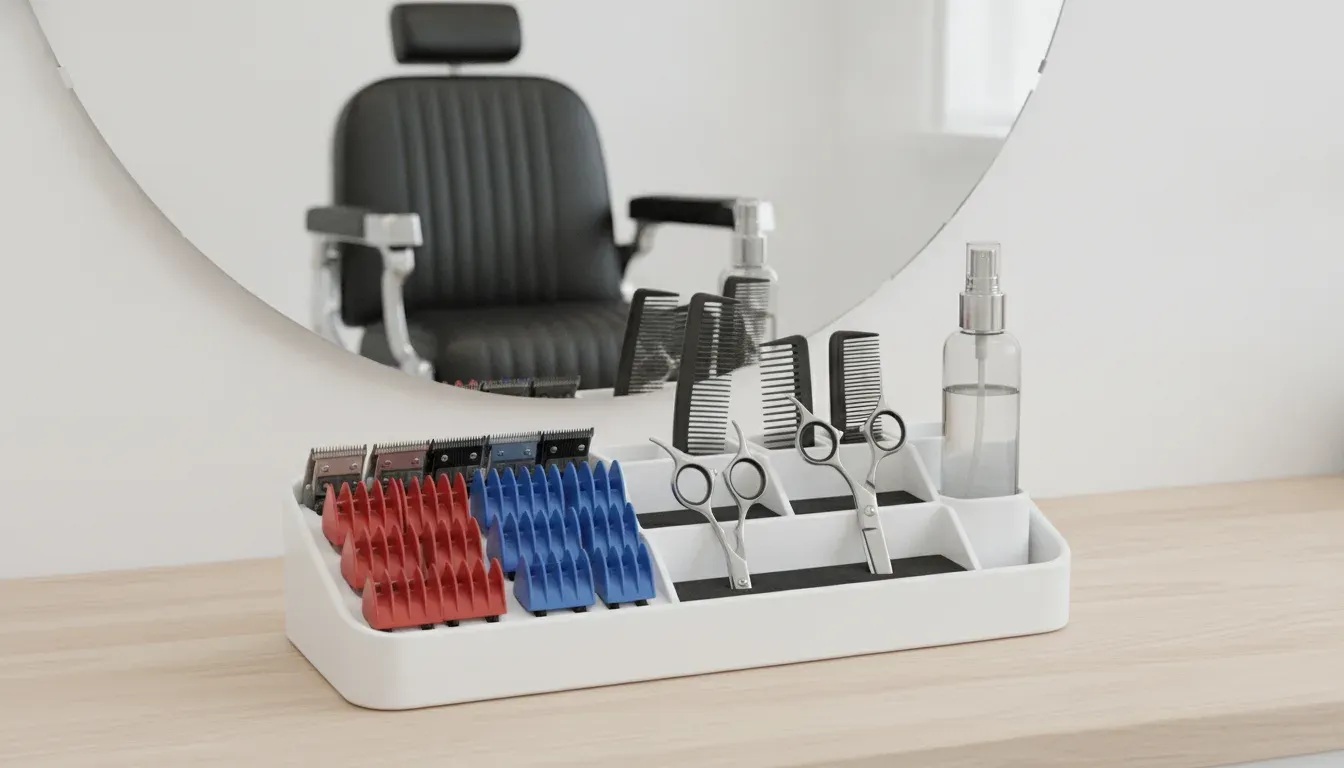
Small accessories deserve deliberate storage too. The Barber Works Taper Comb – Hybrid Ceramic supports comb-and-clipper work without requiring a large footprint. The Barber Works Continuous Mist Sprayer can stay near the cutting area when moisture is part of the service. A Professional Razor Holder – Ultra Exposed gives a precision tool a defined storage location instead of leaving it loose on the counter.
Sanitation, storage, and power
Sanitation supplies should have a dedicated location that is separate from clean tools and client-facing items. Plan room for disinfecting supplies, towels, a waste container, and the routine used to reset the station between clients. Keep only the products needed for the current service on the work surface. Reserve stock can move into a drawer, cabinet, or other closed storage.
Storage is not an afterthought in a compact shop. The Barber Station Organizer is designed to help keep frequently used station items grouped and visible without spreading across the counter. Pair it with a clear charging and cord-management plan. Clippers, trimmers, and other powered tools need accessible outlets or charging points, while cords should not cross the barber’s movement path or the client’s seating area.
Lighting also earns space because it affects how clearly the barber can see the work and how comfortable the client feels at the mirror. Use lighting that supports the service without creating distracting glare. For a broader product-planning list, review this barber supplies in Las Vegas guide and the barbershop equipment checklist. The right setup is not the one with the most equipment. It is the one where each tool has a role, a location, and a clean path back to storage.
How Should a Barber Mirror Be Positioned in a Small Shop?
A barber mirror should give the client a clear, comfortable sightline while leaving the barber enough room to move, work, and access tools without crossing the service path. In a small shop, position the mirror around the chair’s working orientation, then check glare, lighting, adjacent stations, reflections, and mounting stability before committing to the layout.
Start with the client’s sightline
Place the chair so the client can see their reflection naturally while seated, without needing to twist or lean. The mirror should frame the client’s face and upper body during a consultation and remain useful throughout the service. Test the view from the actual chair, not from the doorway or an empty room.
Next, sit or stand where the barber will perform most cutting work. The mirror should support eye contact and visual checks without forcing the barber to work at an awkward angle. Avoid placing it where the chair blocks a cabinet, trolley, or frequently used tool zone. A good position lets the barber step around the client smoothly instead of repeatedly reaching across the chair.
In a compact layout, also study the reflection behind the client. A mirror that faces another mirror can create distracting repeated reflections and make the shop feel visually busy. If stations are adjacent. So angle or separate their sightlines enough to preserve a focused service area and reduce the chance that clients are looking directly into another station’s working space.
Control glare and support even lighting
Glare can make a well-placed mirror frustrating to use. Check how daylight and overhead fixtures appear on the glass at different times of day. Do not position the mirror directly opposite a bright window or a strong exposed light source if that reflection competes with the client’s face.
Lighting should reveal the haircut rather than create hard shadows across one side of the face. Use the mirror position to evaluate the light from the client’s viewpoint and from the barber’s working position. If the shop relies on movable or adjustable lighting. Keeping its movement clear of the barber’s path and confirm that cords do not become a trip or snag hazard.
Mount for stability and daily use
A mirror needs a secure mounting method suited to the wall and the weight of the frame. Stability matters during cleaning, chair movement, and routine contact with the station. Before final installation, confirm that the mounting point does not conflict with electrical access, storage, or future equipment changes.
Small-shop planning works best when the mirror, chair, lighting, storage, and walking path are tested as one system. Mark the proposed position temporarily, view it from the chair, and run through a normal service before drilling or permanently arranging adjacent stations.
How Can You Organize a Barber Workstation to Reduce Clutter?
A practical workstation organization system separates tools by frequency of use. Keep active tools in primary reach, supporting items in secondary reach, and reserve stock in closed storage. Add deliberate cord control and a brief end-of-service reset. This keeps the station ready for the next client without turning the counter into a storage shelf.
Build three reach zones
Primary reach is the area you can access without twisting, stepping away, or interrupting the service. Place the tools used repeatedly during a cut here, such as the current clipper, trimmer, combs, shears, and the product needed for the next step. Use a dedicated holder or tray so each item has a return point. The Barber Station Organizer is designed for this kind of compact tool control, and customers can review related barber supplies in Las Vegas when choosing station accessories.
Secondary reach holds items used less often but still needed during the service. Depending on your workflow, that may include a backup comb, styling product, spray bottle, razor supplies, or sanitation items. Keep these grouped by task rather than scattered across the counter. Reserve stock, including unopened consumables and backup tools, belongs in a drawer, cabinet, or other closed storage away from the active work surface.
Control cords, supplies, and the reset
Cords create visual clutter and can interfere with movement around the chair. Route each power cable toward the outlet using the shortest practical path. Then secure excess length so it does not hang across the station or collect near water and disinfectant. Charge cordless tools in one defined location instead of leaving multiple chargers spread across the counter. Keep waste and used items moving toward their designated containers, not temporary piles.
At the end of every service, return active tools to their assigned positions, remove hair from the surface. Replenish only what the next service needs, and move reserve stock back into closed storage. This reset takes less effort when the station has fewer exposed items. For a broader sequence covering tool zones, sanitation, charging, and daily workflow, use this professional barber station workflow guide.
Review the layout after several services, not just after installation. If the same tool is repeatedly left outside its zone, the zone is probably misplaced or the item needs a more accessible holder. Organization should follow the barber’s actual movement, while keeping the client-facing surface clean and intentional.
Small-Shop Barber Workstation Layouts That Make the Most of Limited Space
A compact barber workstation setup works when the layout supports the full service, not just the chair and mirror. One-wall, corner, and parallel arrangements solve different problems. Compare how each pattern affects movement, reflection, storage, privacy, and the ability to add another station before choosing furniture or mounting equipment.
| Layout. | Best fit. | Primary advantage. | Main tradeoff. |
|---|---|---|---|
| One-wall. | A narrow shop or a single-station room. | Simple circulation and easy visual control. | Less separation between neighboring services. |
| Corner. | A room with an unused corner or irregular footprint. | Uses overlooked wall area and can create privacy. | Can restrict movement if storage projects into the work zone. |
| Parallel or back-to-back. | Multiple stations sharing a central work area. | Supports repeatable station placement and future growth. | Requires careful sightlines, cords, and traffic planning. |
One-wall layouts keep the service path visible
A one-wall arrangement places stations along the same side of the room. It is often the easiest pattern to understand because clients, barbers, and products share a clear direction of travel. Keep the chair, mirror, primary tools, and sanitation supplies aligned so the barber does not need to cross the room repeatedly during a service.
The compromise is privacy. Several stations on one wall may give clients a direct view of neighboring services, and a broad mirror can reflect more activity than intended. Use spacing between visual zones, selective shelving, or a change in mirror width to create distinction without blocking the walking path. Reserve closed storage for items that would otherwise make the wall look crowded.
Corner layouts turn an awkward footprint into a working zone
A corner station can make an irregular room more useful, especially when two walls provide natural support for a mirror, cabinet, or product storage. The chair can face into the room while the barber retains access to tools from one side. This orientation may offer more visual privacy than a straight run of stations.
Check the swing of the chair, cabinet doors, and drawers before committing to the corner. A layout that looks compact on paper can create a bottleneck when a drawer is open or a client is entering the chair. Keep reserve stock outside the active corner and make sure the mirror reflects a useful client view rather than a doorway, glare source, or another station’s busiest area.
Parallel and back-to-back layouts need deliberate sightlines
Parallel stations can establish a repeatable system for a growing shop, while back-to-back stations may reduce the amount of wall space each barber needs. Both patterns require a clear distinction between each barber’s tools, cords, waste handling, and reserve supplies. If stations face one another, test mirror reflections from the seated client position before installation. If they share a central spine, plan how barbers pass without cutting across active services.
Choose the pattern that leaves the easiest path for the next operational change. A one-wall layout may be strongest for a single barber today, while parallel stations may better support expansion later. Sketch the chair, barber movement, mirror view, storage doors, and entry route together. That simple test exposes conflicts before the shop is committed to fixed equipment.
Power, Sanitation, and Maintenance Belong in the Layout
A practical workstation layout accounts for what happens between services, not only where the chair and mirror look best. Outlet access, charging, disinfecting, waste handling, blade care, and repair decisions should shape station placement from the beginning. When these functions have a clear home, the barber can work cleanly without crossing the client path or creating avoidable cord and supply clutter.
Plan power and sanitation around the service flow
Place the station where power is accessible for clippers, trimmers, lighting, and other required tools, while keeping cords controlled and away from walking routes. A charging point should be convenient enough to support the daily rotation of cordless equipment without turning the counter into a pile of devices. If more than one barber shares a wall or counter, consider how simultaneous charging affects outlet access before fixing the furniture in place.
Sanitation needs its own deliberate zone. Keep disinfecting supplies, clean tool storage, and used-item handling distinct so a clean tool does not share an improvised surface with waste or removed hair. A covered bin should be reachable without forcing the barber to leave the client area mid-service. The barbershop equipment checklist can help confirm that the layout supports the required equipment and supplies before opening day.
Make blade care and service access part of the floor plan
Blade maintenance is easier to manage when the workstation has a designated place for tools that need cleaning, inspection, or service. Do not mix a dull or damaged blade with ready-to-use equipment. A small labeled service area, drawer. Or container can keep maintenance items from entering the clean working zone and makes it easier to identify what needs attention at the end of a busy day.
The Barber Company provides verified blade sharpening, clipper repair, and precision zero gapping services. Build those decisions into the setup: if a clipper needs attention, remove it from active rotation and keep a clear path for drop-off and collection. The clipper repair service in Las Vegas page provides a direct reference when equipment needs technical support.
Finish each service by returning tools to their assigned locations, removing waste, and checking that charging and sanitation areas are ready for the next client. This reset keeps the layout functional as well as attractive, which is the standard a well-planned barber workstation setup should meet.
When Should You Upgrade a Barber Workstation Setup?
A workstation upgrade is justified when the current setup repeatedly slows service, creates avoidable clutter, or makes tools harder to use safely. Track recurring friction rather than waiting for a major failure. If your reach zones, charging routine, mirror view, storage, or service mix no longer support the work, targeted changes can improve the station without rebuilding the entire shop.
Look for repeated workflow friction
Notice what happens during several ordinary services. Reaching behind the chair for a clipper, brush, disinfectant. Or finishing product is a strong signal that the station is organized around available furniture instead of the service sequence. So is placing tools on the counter because reserve stock has taken over the primary work area. Repeated cable movement, searching through drawers, and interrupted charging are also upgrade signals.
Clutter is not only a visual problem. It can make sanitation steps harder to perform consistently and leave less room for clean tools during a service. Start by separating primary-use tools, secondary supplies, reserve stock, and waste. Then change the storage or organizer that is causing the overlap. The Barber Station Organizer is one relevant option for keeping frequently used items assigned to a defined station zone.
Upgrade when the station no longer fits the service
Your setup may need to change as your work changes. A barber adding more clipper work, shear work, beard services, color-related services, or retail recommendations may need different storage, lighting, surface area, or accessory placement. A station that worked for occasional appointments can become a bottleneck during a full schedule. Reassess whether every item earns its location and whether the mirror still gives the client a useful reflection without glare or blocked sightlines.
Charging gaps deserve their own check. If cordless tools regularly finish a service with insufficient charge, or chargers compete with disinfecting space and active tools. Review outlet access and the charging location before buying more equipment. Likewise, replace an unstable or poorly positioned mirror when it forces awkward movement or makes detail work harder to inspect.
Use local support for a focused upgrade
A local supplier can help match products to the actual station, service mix, and available storage instead of treating every upgrade as a full-shop purchase. The Barber Company serves professionals and the public, carries brands including Gamma+, Wahl Professional, BaByliss Pro, StyleCraft. Andis Professional, and Utsumi, and provides technical support such as blade sharpening, clipper repair, and precision zero gapping. For a broader purchasing sequence, review the barber shop startup equipment guide. Local delivery and direct guidance can also make it easier to stage improvements one station at a time.
Frequently Asked Questions
What equipment does a barber need for a workstation setup?
A practical station usually includes the tools used most during services, a stable mirror, task lighting, power access, sanitation supplies, waste handling, and storage for backup inventory. Choose each item by its role in the service sequence so the station supports clean movement instead of collecting equipment that rarely leaves the drawer.
How do you set up a small barber workstation?
Start by placing the chair and mirror to create a clear client sightline. Then map the barber’s movement, position frequently used tools in the primary reach zone, and place reserve stock in closed or secondary storage. Check charging, outlet access, walking paths, and end-of-service reset before adding decorative elements.
How can you organize a barber workstation to reduce clutter?
Separate daily-use tools from reserve supplies. Keep clippers, combs, guards, and finishing products in assigned locations, while storing backups out of the active work zone. Use an organizer or closed cabinet for small items, manage cords deliberately, and reset the station after every service so clutter does not become part of the workflow.
How should a barber mirror be positioned in a small shop?
Position the mirror so the client can see the finished work comfortably and the barber can work without blocking the reflection. Check glare at different times of day, coordinate the mirror with task lighting, and consider adjacent stations before mounting it. Stability matters, especially where movement and cleaning are frequent.
Ready to Build a More Efficient Workstation?
A well-planned workstation can make daily tool access, mirror positioning, and cleanup more manageable in a small shop. The Barber Company can help you review workstation products, delivery guidance, and technical maintenance support for your setup.
Call The Barber Company at (702) 900-9972 to discuss your needs or plan a store visit.
Visit The Barber Company store for professional barber supplies.
Follow The Barber Company on Instagram for store updates and barber-focused product guidance.
The Barber Company, 4700 Meadows Ln #110, Las Vegas, NV 89107, (702) 900-9972.